Taxi App Development Cost in India (2026): Build an App Like Ola, Uber & Rapido
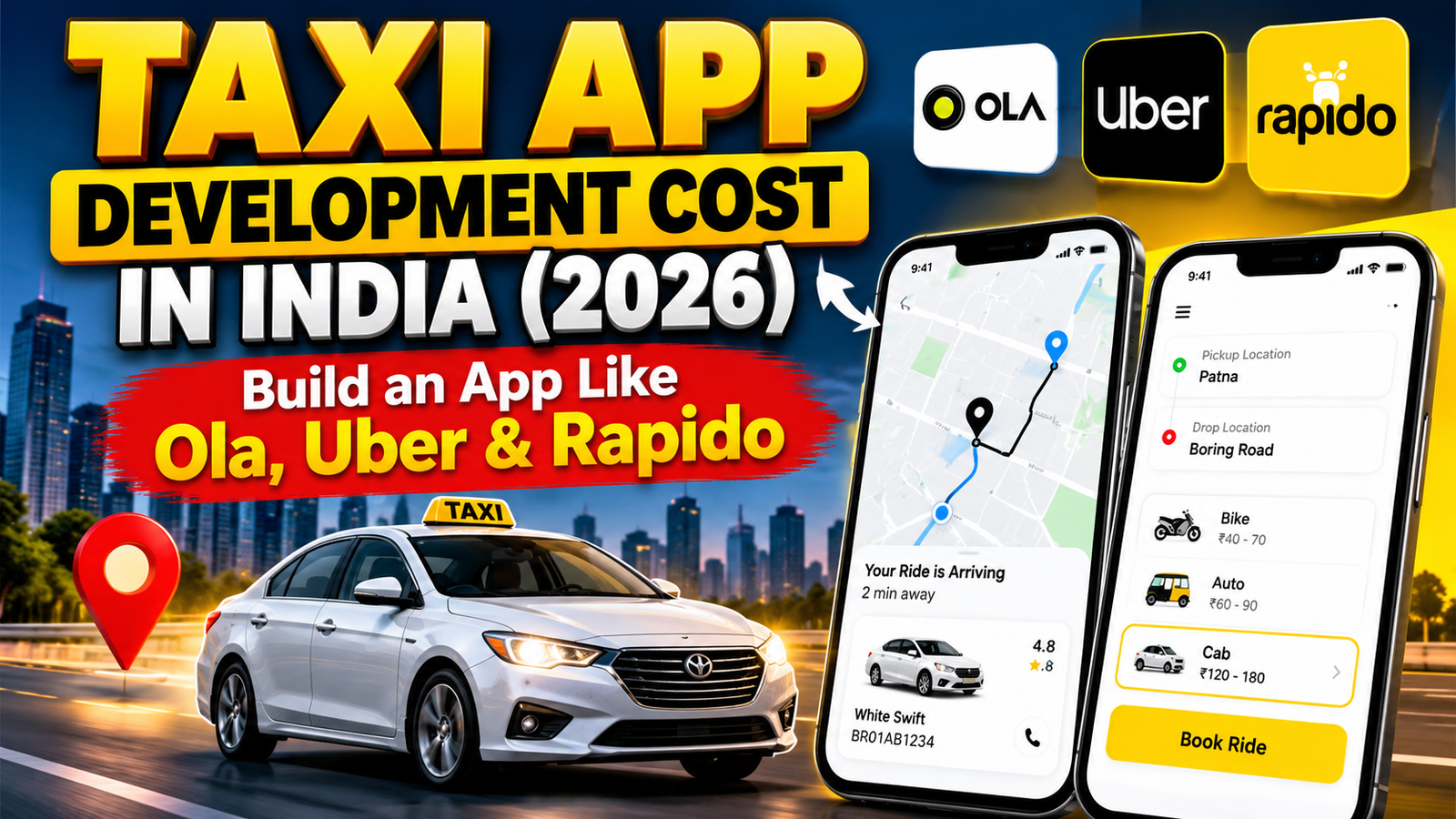
Taxi App Development Cost in India (2026): Build an App Like Ola, Uber & Rapido
Introduction
India’s mobility market has moved far beyond simple cab booking. Auto-rickshaws, bike taxis, outstation rides and rentals now sit inside one app, and platforms like Ola, Uber and Rapido have made on-demand transport a daily habit for millions of people.
For founders, fleet owners and logistics entrepreneurs, this makes ride-hailing one of the most attractive digital businesses to launch. But the first question is always the same: what is the real cost of building an app like Ola, Uber or Rapido in India?
This guide covers realistic 2026 cost ranges, feature-wise pricing, hidden running costs, the right tech stack, the development timeline and a comparison of five taxi app development companies in India.
Quick Answer: How Much Does a Taxi App Cost in India?
| Development Scope | Estimated Cost (INR) | Approx. USD | Timeline |
|---|---|---|---|
| White-label / MVP launch | ₹3.5 – ₹8.5 lakh | $4,500 – $10,500 | 3–6 weeks |
| Custom mid-tier platform | ₹12 – ₹28 lakh | $15,000 – $35,000 | 3–5 months |
| Enterprise multi-service system | ₹30 – ₹65 lakh+ | $38,000 – $80,000+ | 6–10 months |
These are indicative ranges. The final price depends on features, platforms, integrations, design depth and the team you hire, so always request a written, milestone-based estimate.
Understanding the Ola, Uber and Rapido Business Model
Before choosing a budget, know what you are building. These platforms are two-sided marketplaces connecting riders and drivers, and they earn mainly through:
- Commission per ride (a percentage of the fare)
- Subscription or SaaS models for drivers, increasingly popular with bike-taxi and auto platforms
- Surge or dynamic pricing during high demand
- Ads, rentals, outstation and delivery services
Your revenue model affects your feature list, which in turn affects your cost.
The Three Products You Actually Need to Build
A ride-hailing platform is not one app. It is three products working in real-time sync:
- Rider app (Android and iOS)
- Driver app (Android and iOS)
- Admin dashboard / dispatch panel (web)
All three connect to a real-time backend that handles GPS updates, ride matching, payments and notifications. Many first-time founders budget only for the rider app, then discover that the driver app and admin panel cost just as much.
Feature-Wise Cost Breakdown
| Module | What It Does | Estimated Cost |
|---|---|---|
| Real-time GPS tracking and maps | Live vehicle movement, route calculation, ETA and navigation via Google Maps or Mapbox | ₹3.5 – ₹6.5 lakh |
| Smart dispatch and auto-matching | Allocates the nearest suitable driver using proximity and acceptance logic | ₹4.5 – ₹8.5 lakh |
| Dynamic surge pricing | Adjusts fares by demand, traffic and time | ₹4 – ₹7.5 lakh |
| Multi-payment integration | Razorpay, Paytm, PhonePe, UPI, cards, cash ledger | ₹2.5 – ₹5 lakh |
| Masked calling and in-app chat | Contact between rider and driver without sharing phone numbers | ₹2.5 – ₹4.5 lakh |
| Driver onboarding and KYC | Upload and verification of DL, RC and insurance documents | ₹3 – ₹6 lakh |
| Admin panel and analytics | Fleet management, heatmaps, payouts, commission and fraud controls | ₹5 – ₹10 lakh |
Remember that these are module-level figures. A white-label product bundles many of them at a much lower combined price, while a custom build prices each one separately.
Key Factors That Decide Your Final Cost
1. Platform choice
Building natively for Android and iOS costs more than using a cross-platform framework like Flutter or React Native. For most startups, cross-platform is the smarter starting point.
2. Custom build vs white-label
A white-label taxi app is a pre-built product you brand and launch quickly. It is cheaper and faster, but customisation is limited. A custom build gives you full control over workflows, pricing logic and scale, at a higher cost and longer timeline.
3. Vehicle categories
Supporting only bike taxis is simpler than supporting bikes, autos, cabs, rentals and outstation rides together. Each category adds fare rules, vehicle verification and admin configuration.
4. UI/UX complexity
Rider and driver journeys must be extremely simple. Good design reduces booking steps and increases driver acceptance rates, and it takes real design time.
5. Third-party integrations
Maps, payments, SMS, push notifications, KYC verification and WhatsApp updates all add cost, both for integration and for ongoing usage.
6. Team location and experience
Rates vary between freelancers, small agencies and large IT firms. The cheapest quote is rarely the cheapest outcome if the app crashes during peak hours.
Hidden and Ongoing Costs Most Founders Forget
Development is only the beginning. A live ride-hailing app carries monthly running costs:
- Maps API (Google Maps / Mapbox): from a few thousand rupees at low volume to lakhs per month at high trip volume. Maps are often the biggest recurring expense.
- Cloud hosting (AWS / GCP): real-time WebSocket communication needs low-latency servers, and costs grow with active users.
- SMS OTP and push notifications: a smaller but steady cost for logins and trip alerts.
- App store accounts: Google Play has a one-time fee of about $25, and the Apple Developer Program costs $99 per year.
- Maintenance and updates: budget regularly for bug fixes, OS updates, security patches and feature releases.
- Driver and rider acquisition: incentives, offers and marketing often exceed the development budget in the first year.
A practical rule is to keep a monthly running budget in addition to the build cost, and to plan for several months of runway before the marketplace reaches critical mass.
Recommended Tech Stack for a Scalable Mobility App
A platform that updates driver locations every few seconds needs a fast, concurrent backend.
| Layer | Recommended Technologies |
|---|---|
| Mobile apps | Flutter, React Native, or Swift (iOS) and Kotlin (Android) |
| Backend | Node.js, Go or Python microservices |
| Real-time communication | WebSockets, Socket.io, MQTT |
| Databases | PostgreSQL (transactions), Redis (caching and driver state), MongoDB (geospatial queries) |
| Cloud and DevOps | AWS or GCP, Docker, Kubernetes, CDN |
| Maps | Google Maps Platform or Mapbox |
| Payments | Razorpay, Paytm, PhonePe, UPI |
Step-by-Step Development Process and Timeline
- Requirements and market planning (1–2 weeks): Decide your vehicle types, city, pricing model, commission structure and local compliance needs.
- UI/UX design (2–3 weeks): Wireframe rider and driver journeys to cut clicks and improve acceptance rates.
- Core development (6–10 weeks): Build the rider app, driver app, API gateway, dispatch logic and admin dashboard in parallel.
- Geospatial and load testing (2–3 weeks): Simulate live movement, weak networks, GPS drift and peak-hour traffic.
- Deployment and go-live (about 1 week): Publish to the Play Store and App Store and set up production servers.
White-label launches can be much faster, since most modules already exist.
Top 5 Taxi App Development Companies in India
Choosing the right partner decides whether your app scales smoothly or crashes in peak hours. Here are five companies to evaluate. Always verify reviews, past work and contract terms yourself before signing.
1. Super Square Pvt. Ltd.
Super Square has operated since 2019 and builds custom and white-label software, including taxi, auto and bike-taxi platforms. It highlights 100% source code ownership, scalable architecture and post-launch support.
Best for: Startups, SMEs and fleet operators who want full ownership and a custom or white-label route.
Ready to Launch Your Mobility Platform?
Super Square Pvt. Ltd. offers custom and white-label taxi, auto and bike-taxi app development, with a free consultation and project estimate.
📞 Call / WhatsApp: +91 7033814333
🌐 Website: www.supersquare.in
2. Creators Mind
Creators Mind, operating since 2019, builds apps, websites and digital solutions, with a strong base in education and creator-led businesses. It suits founders who want a branded app supported by design and digital marketing.
Best for: Early-stage ventures that need an app plus branding and content support.
3. Chingari Media
Chingari Media combines app development with digital marketing, which helps businesses that need both a product and a launch plan.
Best for: Local transport businesses needing basic digital integration and marketing.
4. Hyperlink InfoSystem
A large Indian IT services company with a big multi-stack team, offering mobile and enterprise application development across many industries.
Best for: Businesses that want a large outsourcing partner for standard web and mobile projects.
5. Apptunix
A mobile app development firm known for on-demand service platforms and ready-made app frameworks, including ride-sharing.
Best for: Founders exploring on-demand and white-label ride-booking setups.
How to Compare Them
| Criteria | What to Ask Every Company |
|---|---|
| Source code | Do you get full, unencrypted source code and IP rights? |
| Scale | Can they show a live app handling concurrent drivers and riders? |
| Deployment | Do they offer white-label, custom or both? |
| Support | How long is post-launch support, and is it under a written SLA? |
| Pricing | Is it fixed, milestone-based and free of hidden charges? |
| Proof | Can they share real case studies and client references? |
White-Label vs Custom Taxi App: Which Should You Choose?
Choose white-label if you want to validate a market quickly, have a limited budget and can work within a standard feature set. You launch in weeks and test demand before investing further.
Choose custom if you need unique workflows, special pricing models, deep integrations or plan to scale to multiple cities. It costs more upfront but avoids rebuild costs later.
Many founders start white-label to prove demand, then move to custom engineering once revenue justifies it. If you go this route, make sure your contract lets you migrate your data and code.
Compliance and Legal Points for Indian Operators
Before launch, check:
- State transport rules and aggregator licensing, which vary by state and vehicle type
- Motor vehicle aggregator guidelines issued by the government, including driver verification and safety requirements
- Data protection obligations under India’s Digital Personal Data Protection Act, 2023
- Insurance, driver background checks and emergency features such as an SOS button
Regulations change, so confirm current requirements with a legal advisor in your operating state.
Buyer’s Checklist Before Hiring a Mobility App Developer
- Full source code transfer and IP ownership in the contract
- Scalable microservices backend that can handle thousands of live GPS updates
- Admin control over fares, surge rules, commission and promo codes
- White-label branding with your own logo, domain and payment credentials
- Data encryption and privacy compliance
- Clear milestones, payment schedule and post-launch support terms
Frequently Asked Questions
1. What is the minimum cost to build an Ola or Uber clone in India?
A basic white-label MVP with ride booking, map tracking and payments typically starts around ₹3.5 to ₹8.5 lakh, depending on the provider and customisation.
2. How long does it take to build a bike taxi app like Rapido?
A white-label platform can launch in 3 to 6 weeks. A custom multi-tier platform usually takes 3 to 6 months.
3. Do I get full source code ownership?
It depends on the company and contract. Always confirm in writing that you receive complete source code and IP rights with no recurring platform commission.
4. Which is better: custom development or a white-label script?
White-label is best for fast, low-cost validation. Custom development is better for unique workflows and long-term scale.
5. What third-party costs are involved in a ride-hailing app?
The main ones are maps (Google Maps or Mapbox), payment gateway fees (Razorpay, Paytm), SMS and OTP services, cloud hosting and push notifications.
6. Can one app support bikes, autos and cabs?
Yes. A well-built admin panel lets you configure multiple vehicle categories, fares and commission rules from one dashboard.
7. How do driver payouts work?
The system calculates the fare, deducts the platform commission and credits the driver’s wallet, which can then be settled to a bank account.
8. How does AI help in taxi apps?
AI improves ride matching, predicts high-demand zones, supports dynamic pricing and speeds up document verification.
9. Is the app cost a one-time expense?
No. Beyond development, expect recurring costs for servers, maps, SMS, maintenance and marketing.
10. How do I get an accurate quote for my project?
Share your city, vehicle types, platforms and feature list with two or three companies, and ask for a detailed milestone-wise estimate.
Conclusion
Building an app like Ola, Uber or Rapido is a serious but achievable investment. A white-label launch can start under ₹10 lakh, while a full custom platform can run into tens of lakhs. The right choice depends on your market, budget and growth plans.
Whatever route you take, prioritise source code ownership, scalable architecture, transparent pricing and strong post-launch support, and budget for running costs, not just development.
Ready to Launch Your Mobility Platform?
Super Square Pvt. Ltd. offers custom and white-label taxi, auto and bike-taxi app development, with a free consultation and project estimate.
📞 Call / WhatsApp: +91 7033814333
🌐 Website: www.supersquare.in
Need Custom App or AI Solutions?
SuperSquare helps businesses scale with custom application development and autonomous AI workflows.