How to Choose the Best App Development Company for Your Startup
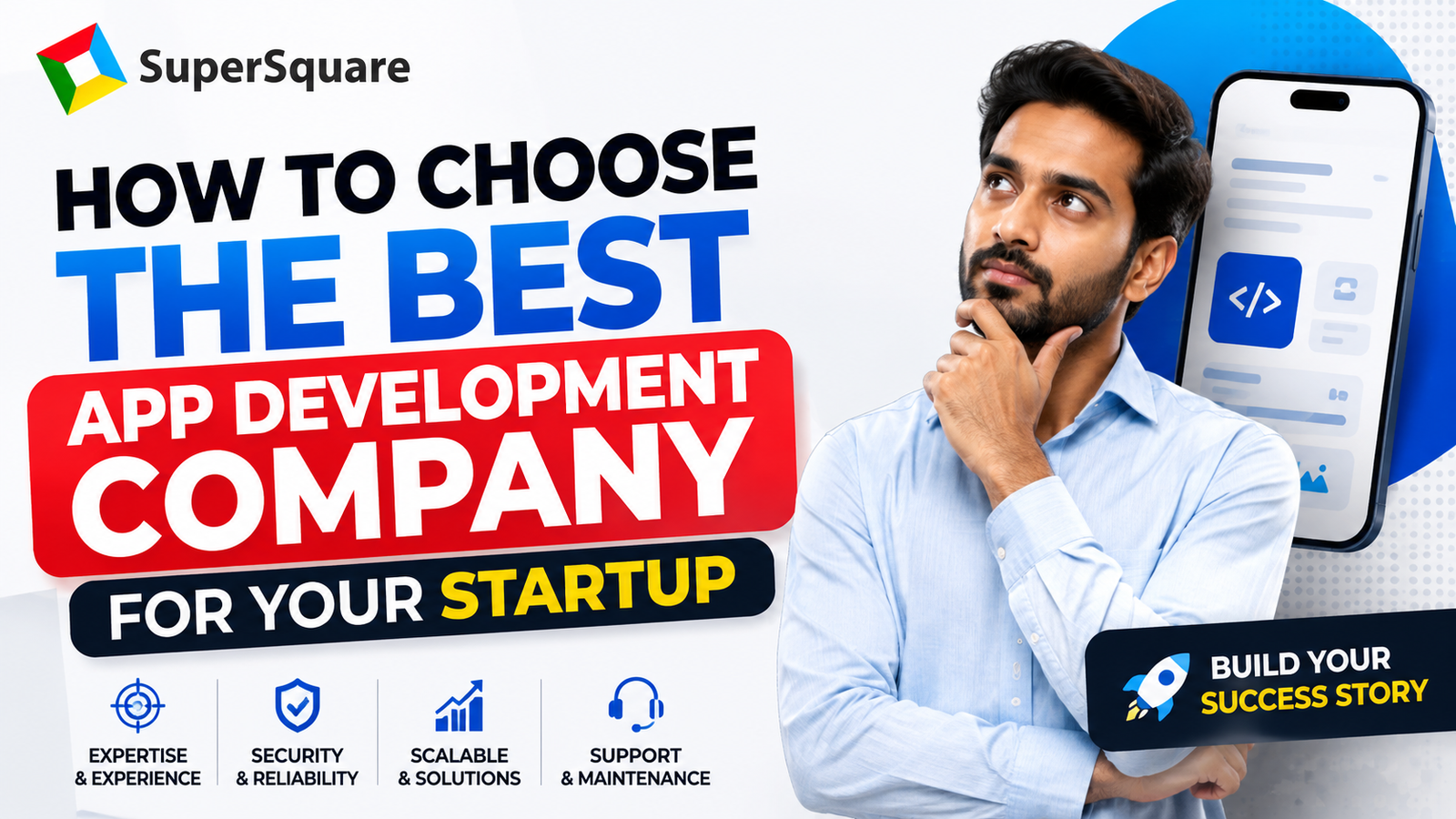
How to Choose the Best App Development Company for Your Startup
Introduction
India’s startup ecosystem is now the third-largest in the world, with over 1,17,000 DPIIT-recognized startups competing for user attention on mobile-first platforms. Yet a striking industry reality persists: nearly 90% of startups fail, and a significant share of that failure traces back not to a bad business idea, but to a poorly executed digital product — bloated budgets, missed launch windows, unscalable code, and apps that simply don’t perform under real-world load.
For a founder, the mobile or web application is the business. It is the storefront, the sales team, and the brand experience rolled into one. Choosing the wrong development partner doesn’t just delay a launch — it can drain runway, alienate early adopters, and hand competitors a first-mover advantage that’s nearly impossible to reclaim.
The core pain point is rarely a shortage of developers. It’s a shortage of the right partner — one who understands startup constraints (speed, budget, scalability), communicates transparently, and builds with enterprise-grade discipline from day one.
This guide breaks down exactly how to evaluate, shortlist, and select an app development company that aligns with your startup’s technical needs, business goals, and growth trajectory — so your product is built once, built right, and built to scale.
Table of Contents
- Why Choosing the Right App Development Partner Is a Business-Critical Decision
- Key Criteria to Evaluate an App Development Company
- Red Flags to Watch Out For
- Agency vs. Freelancer vs. In-House: What’s Right for a Startup?
- Understanding Cost, Contracts & Source Code Ownership
- The SuperSquare Advantage
- Conclusion & Strategic Summary
- Get in Touch
Why Choosing the Right App Development Partner Is a Business-Critical Decision
An app development company isn’t a vendor you check off a procurement list — it’s a technology co-founder for the duration of your build. The decision impacts your:
- Time-to-market — every week of delay is a week competitors can capture
- Burn rate — inefficient development directly erodes limited startup capital
- Scalability — architecture decisions made in month one determine whether you can handle month twelve’s user growth
- Investor confidence — a stable, well-engineered product is a due-diligence asset during fundraising
Pro Tip: Before you evaluate a single agency, document your MVP scope, target platforms (iOS/Android/Web), expected user load in Year 1, and non-negotiable integrations (payment gateways, CRM, analytics). A vague brief invariably produces vague — and inflated — quotes.
Key Criteria to Evaluate an App Development Company
1. Technical Depth Across the Full Stack
A capable partner should demonstrate proficiency across native and cross-platform development (Swift/Kotlin, Flutter, React Native), backend architecture (Node.js, Python, Java), cloud infrastructure (AWS, Azure, GCP), and DevOps practices (CI/CD pipelines, automated testing). Ask for architecture diagrams from past projects, not just UI screenshots.
2. Startup-Specific Experience
A company that primarily serves large enterprises may over-engineer your MVP, inflating cost and timeline. Look for a partner with a demonstrated track record building Minimum Viable Products (MVPs), iterating based on user feedback, and scaling applications post-funding.
3. Transparent Development Methodology
The best partners work in Agile sprints with visible progress — not black-box development that resurfaces six weeks later with a “finished” product. Ask:
- How often will I receive builds or demos?
- What project management tool will we use (Jira, Trello, ClickUp)?
- Who is my single point of contact?
4. Security & Compliance Standards
Especially critical for FinTech, EdTech, and healthcare startups handling sensitive user data. Verify their approach to:
| Compliance Area | What to Ask |
|---|---|
| Data Protection | GDPR / India’s DPDP Act readiness |
| Payment Security | PCI-DSS compliance for FinTech apps |
| Infrastructure | Penetration testing, encryption standards |
| Access Control | Role-based access, audit logs |
5. Post-Launch Support & Scalability Planning
Launch is the beginning, not the end. Confirm their SLA for bug fixes, availability for feature iterations, and whether the architecture supports horizontal scaling as your user base grows from thousands to millions.
6. Portfolio Relevance and Client References
Generic portfolios showcasing dozens of unrelated apps are less valuable than 2–3 case studies closely matching your industry and complexity. Always request direct references and ask past clients about timeline adherence and post-launch responsiveness.
Industry Insight: According to CB Insights research on startup failure, cash flow problems and running out of runway remain top reasons startups shut down — often accelerated by development cost overruns from scope creep and unclear vendor contracts.
Red Flags to Watch Out For
Be cautious if a prospective partner exhibits any of the following:
- Unrealistically low quotes with no clarity on what’s included
- Reluctance to sign an NDA before discussing your idea in detail
- No clear IP or source code ownership clause in the contract
- Overpromising timelines for complex builds (e.g., “full FinTech app in 2 weeks”)
- No dedicated QA process — testing treated as an afterthought
- Communication gaps — delayed responses during the sales process often predict worse during development
Agency vs. Freelancer vs. In-House: What’s Right for a Startup?
| Factor | Freelancer | In-House Team | Development Agency |
|---|---|---|---|
| Cost (Initial) | Lowest | Highest | Moderate |
| Speed to Start | Fast | Slow (hiring cycle) | Fast |
| Skill Diversity | Limited | Depends on hires | Broad (full-stack teams) |
| Scalability | Poor | Moderate | High |
| Accountability | Low | High | High (contractual SLAs) |
| Long-Term Reliability | Risky | Best (if funded) | Strong |
For most early-stage startups operating under funding constraints, a specialized development agency offers the optimal balance: enterprise-grade processes without the fixed overhead of a full in-house team, and far greater reliability than a solo freelancer.
When In-House Makes Sense
Once product-market fit is established and the roadmap demands continuous, rapid iteration, transitioning core engineering in-house — while retaining an agency for specialized work (AI/ML, DevOps) — often becomes the optimal hybrid model.
Understanding Cost, Contracts & Source Code Ownership
Startup founders frequently underestimate the importance of contractual clarity. Before signing, insist on:
- Fixed-price vs. Time & Material clarity — know which model applies to which phase of your project
- 100% source code and IP ownership transferred to you upon final payment
- Milestone-based payment structures tied to deliverables, not arbitrary dates
- Detailed Statement of Work (SOW) outlining exact features, exclusions, and revision limits
Pro Tip: Never sign a contract where source code ownership is ambiguous or retained by the vendor. This single clause can determine whether you can migrate developers, scale independently, or attract investors without legal complications later.
The SuperSquare Advantage
At SuperSquare Pvt. Ltd., we’ve engineered our entire development philosophy around what startups actually need: speed without compromise, transparency at every sprint, and architecture that scales from your first hundred users to your first million. Our teams work across Custom Software, AI Solutions, Mobile Apps, SaaS, and EdTech/FinTech automation, giving founders a single accountable partner instead of a fragmented vendor stack.
We combine enterprise-grade security protocols, agile delivery frameworks, and cloud-native scalable architecture with the agility startups demand — backed by:
- Serving PAN India
- 5+ Lakh Happy Customers
- 100% Source Code Ownership
- White-Label Solutions
- Engineering Digital Excellence Since 2019
Whether you need an MVP validated in weeks or a full-scale enterprise platform, SuperSquare builds technology designed to power your next stage of growth — not just your launch.
Conclusion & Strategic Summary
Selecting the right app development company is one of the highest-leverage decisions a startup founder will make. Prioritize partners with proven startup experience, transparent agile processes, robust security standards, and unambiguous source code ownership terms. Avoid vendors offering unrealistically low quotes or vague contracts, and always validate technical depth through real case studies and references. The right partner doesn’t just write code — they become a long-term technology ally invested in your scale, security, and success.
Ready to Build Your Startup’s Next Big Product?
Partner with SuperSquare Pvt. Ltd. — Engineering Digital Excellence Since 2019.
📞 Call / WhatsApp: +91 7033814333 🌐 Website: www.supersquare.in 📍 Coverage: PAN India
Get a free consultation and project estimate today — turn your startup vision into a scalable, secure, and market-ready application.
Why choose SuperSquare for startup app development?
SuperSquare provides custom mobile apps, scalable software solutions, AI integration, source-code ownership, and technical support across India.
How do I choose the best app development company for my startup?
Compare experience, portfolio, technology, pricing, security, ownership, and post-launch support.
How much does startup app development cost in India?
Cost depends on features, platforms, integrations, design, backend, and overall app complexity.
What is the best technology for startup app development?
Flutter, React Native, Kotlin, Swift, and other technologies can be suitable depending on project requirements.
Should a startup build an Android or iOS app first?
The choice depends on your target audience, market, budget, and business strategy.
What features should a startup app have?
Common features include user login, payments, notifications, analytics, search, profiles, and an admin panel.
Why choose custom app development for a startup?
Custom development provides greater flexibility, scalability, branding, and control over your product.
What is MVP app development?
An MVP is a minimum viable product designed to launch essential features and validate the business idea.
How long does it take to develop a startup app?
Development time depends on the app’s features, complexity, technology, integrations, and testing requirements.
Who owns the source code of a custom app?
Source-code ownership should be clearly defined in the development contract before the project begins.
Need Custom App or AI Solutions?
SuperSquare helps businesses scale with custom application development and autonomous AI workflows.