Food Delivery App Development Cost in India (2026): Build an App Like Zomato & Swiggy
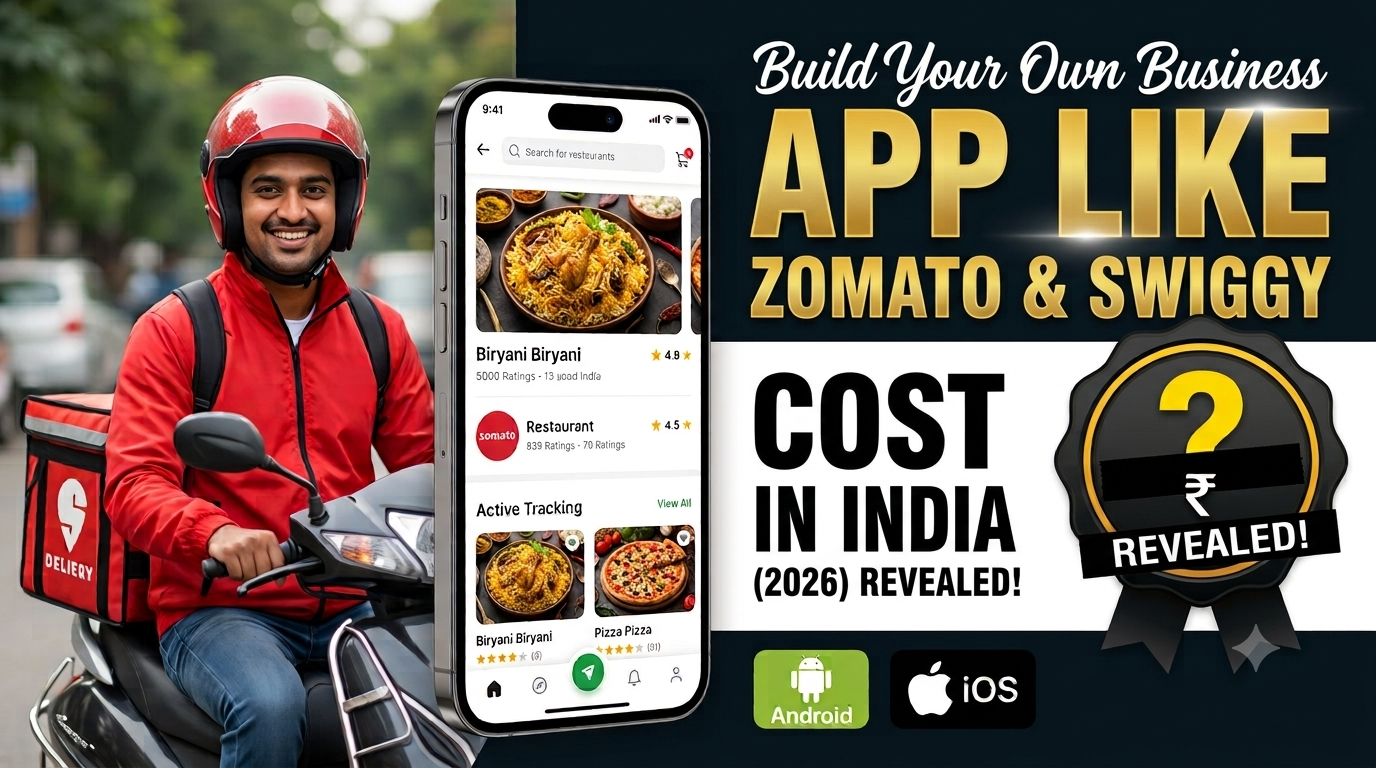
Food Delivery App Development Cost in India (2026): Build an App Like Zomato & Swiggy
Introduction
India’s food delivery market has grown far beyond a few metro cities. Platforms like Zomato and Swiggy have made online food ordering a daily habit across Tier-1, Tier-2 and Tier-3 cities, and cloud kitchens, restaurant chains and hyperlocal delivery startups are following the same path.
For restaurant owners, cloud kitchen operators and food-tech entrepreneurs, launching an ordering platform of their own is an attractive opportunity. It also raises the most important question: how much does it cost to build a food delivery app like Zomato or Swiggy in India?
This guide covers realistic 2026 cost ranges, feature-wise pricing, hidden running costs, the tech stack, the development timeline and five food delivery app development companies to evaluate.
Quick Answer: How Much Does a Food Delivery App Cost in India?
| Development Level | Estimated Cost (INR) | Approx. USD | Timeline |
|---|---|---|---|
| White-label / MVP launch | ₹3.5 – ₹8.5 lakh | $4,500 – $10,500 | 3–6 weeks |
| Custom mid-tier platform | ₹12 – ₹28 lakh | $15,000 – $35,000 | 3–5 months |
| Enterprise scalable system | ₹30 – ₹60 lakh+ | $38,000 – $75,000+ | 6–10 months |
These are indicative ranges. The final price depends on features, platforms, integrations, design depth and the team you hire, so always ask for a written, milestone-based estimate.
How Zomato and Swiggy Make Money
Before setting a budget, understand the model you are building. Food delivery platforms are multi-sided marketplaces that connect customers, restaurants and delivery partners. Revenue usually comes from:
- Commission on every order charged to restaurants
- Delivery and platform fees charged to customers
- Advertising and promoted listings for restaurants
- Subscription programmes for free delivery or discounts
- Cloud kitchen and private-label brands
Your revenue model decides which modules you need, and that directly affects your cost.
The Four Apps in a Food Delivery Ecosystem
A complete platform is not one app. It is four connected products running on a shared real-time backend:
- Customer app (Android and iOS) for browsing, ordering, paying and tracking
- Restaurant partner app or web panel for accepting orders, managing menus and tracking payouts
- Delivery partner app (Android and iOS) for accepting deliveries, navigation and earnings
- Super-admin panel for managing vendors, orders, commissions, offers and analytics
Many first-time founders budget only for the customer app. In reality, the restaurant app, delivery app and admin panel are equally important and need to be planned from day one.
Feature-Wise Cost Breakdown
| Module | What It Does | Estimated Cost |
|---|---|---|
| Real-time map and route tracking | Live order tracking, ETA prediction and driver distance via Google Maps or Mapbox | ₹3.5 – ₹6.5 lakh |
| Smart order allocation engine | Assigns the nearest delivery partner based on distance and preparation time | ₹4.5 – ₹8.5 lakh |
| Dynamic menu and inventory management | Item availability toggles, add-ons, variants and kitchen controls | ₹3 – ₹5.5 lakh |
| Multi-payment gateway suite | UPI, cards, net banking, wallets and cash on delivery | ₹2.5 – ₹4.5 lakh |
| Commission and payout management | Auto commission deduction, restaurant payouts, tip splitting and tax handling | ₹4 – ₹7 lakh |
| Masked calling and push alerts | Customer-to-driver contact without sharing numbers, plus instant order updates | ₹2 – ₹4 lakh |
| Admin control and analytics | Live order management, revenue reports, promo engine, surge controls and fraud alerts | ₹5 – ₹10 lakh |
These are module-level figures for a fully custom build. A white-label product bundles many modules at a much lower combined price, which is why MVP costs are far below the sum of this table.
Key Factors That Decide Your Final Cost
1. Single restaurant vs multi-vendor marketplace
An app for one restaurant or one cloud kitchen brand is simpler and cheaper because it needs no vendor onboarding or multi-vendor commission system. A Zomato-style aggregator needs both.
2. Custom build vs white-label
White-label is a pre-built product you brand and launch quickly. It costs less but offers limited customisation. A custom build gives full control over workflows, pricing and scale, with a higher budget and longer timeline.
3. Platform choice
Building natively for Android and iOS costs more than using Flutter or React Native. For most startups, cross-platform is the smarter starting point.
4. UI/UX complexity
Ordering must take very few taps. Good design lifts conversion and repeat orders, and it takes genuine design time.
5. Third-party integrations
Maps, payment gateways, SMS, push notifications and WhatsApp updates add both integration cost and ongoing usage fees.
6. Team experience
Rates differ between freelancers, small agencies and large IT firms. The lowest quote often becomes the most expensive if the app fails during lunch and dinner peaks.
Hidden and Ongoing Costs Most Founders Forget
Development is only the first expense. A live food delivery platform has recurring costs:
- Maps API (Google Maps / Mapbox): from a few thousand rupees at low volume to lakhs per month at high order volume. This is often the largest recurring cost.
- Cloud hosting (AWS / GCP / Azure): real-time tracking needs low-latency servers, and costs rise with active users.
- SMS, OTP and push notifications: smaller but steady monthly costs.
- App store accounts: Google Play has a one-time fee of about $25, and the Apple Developer Program costs $99 per year.
- Maintenance and updates: bug fixes, OS compatibility, security patches and new features.
- Restaurant and customer acquisition: onboarding restaurants, delivery partner incentives and customer discounts often exceed the development budget in the first year.
Plan a monthly running budget on top of the build cost, and keep several months of runway before the marketplace gains traction.
Recommended Tech Stack for a Scalable Food Delivery App
| Layer | Recommended Technologies |
|---|---|
| Mobile apps | Flutter, React Native, or Kotlin (Android) and Swift (iOS) |
| Backend | Node.js, Go or Python microservices |
| Real-time communication | WebSockets, Socket.io, MQTT |
| Databases | PostgreSQL (transactions), Redis (cart and driver state), MongoDB (geospatial data) |
| Cloud and DevOps | AWS or GCP, Docker, Kubernetes, CDN |
| Maps | Google Maps Platform or Mapbox |
| Payments | Razorpay, Paytm, PhonePe, Cashfree, UPI |
Step-by-Step Development Process and Timeline
- Discovery and wireframing (1–2 weeks): Define your market, user flows, vendor model and architecture.
- UI/UX prototyping (2–3 weeks): Design customer, restaurant and delivery partner interfaces.
- Core development (6–10 weeks): Build the order engine, payment integration, dispatch logic and all four apps.
- Testing and load testing (2–3 weeks): Check GPS accuracy, payment flows and peak-hour performance.
- Deployment and launch (about 1 week): Publish to the Play Store and App Store and set up production servers.
White-label launches can be much faster because most modules already exist.
Top 5 Food Delivery App Development Companies in India
The right partner decides whether your platform handles lunch and dinner rushes smoothly. Here are five companies worth evaluating. Always verify reviews, past projects and contract terms yourself before signing.
1. Super Square Pvt. Ltd.
Operating since 2019, Super Square builds custom and white-label software, including food delivery and on-demand platforms. It highlights 100% source code ownership, scalable architecture and post-launch support.
Best for: Startups, cloud kitchen chains and food aggregators that want full IP control.
Super Square Pvt. Ltd. offers custom and white-label food delivery app development with a free consultation and project estimate.
📞 Call / WhatsApp: +91 7033814333
🌐 Website: www.supersquare
2. Creators Mind
Creators Mind, operating since 2019, builds apps, websites and digital solutions, with a strong base in education and creator-led businesses. It suits founders who want a branded app supported by design and digital marketing.
Best for: Emerging food brands that need an app along with branding and content.
3. Chingari Media
Chingari Media combines app development with digital marketing, which helps when you need both a product and a launch strategy.
Best for: Local restaurant chains starting their digital transition.
4. Hyperlink InfoSystem
A large Indian IT services company with a big multi-technology team, offering mobile and web development across many industries.
Best for: Businesses that want a large outsourcing partner for standard projects.
5. Code Brew Labs
A software firm known for on-demand apps and ready-made frameworks for marketplace and delivery businesses.
Best for: Founders exploring quick-launch, white-label delivery setups.
How to Compare Them
| Criteria | What to Ask Every Company |
|---|---|
| Source code | Do you receive full, unencrypted source code and IP rights? |
| Scale | Can they show a live app handling many concurrent orders? |
| Deployment | Do they offer white-label, custom or both? |
| Support | How long is post-launch support, and is it under a written SLA? |
| Pricing | Is it fixed, milestone-based and free of hidden charges? |
| Proof | Can they share real case studies and client references? |
White-Label vs Custom Food Delivery App: Which Is Better?
Choose white-label if you want to validate demand in one city, have a limited budget and can work with a standard feature set. You launch in weeks and test the market before investing more.
Choose custom if you need unique workflows, special delivery logic, deep integrations or plan to expand across cities. It costs more upfront but avoids expensive rebuilds later.
Many founders start with white-label and move to custom once revenue justifies it. If you choose this route, make sure your contract lets you migrate data and code.
Legal and Compliance Checklist for Food Delivery in India
Before launch, confirm:
- FSSAI licence for restaurants and food businesses on your platform
- GST registration and correct tax handling for orders and commissions
- Data protection obligations under India’s Digital Personal Data Protection Act, 2023
- Payment compliance through RBI-regulated payment gateways
- Delivery partner terms, insurance and safety requirements
Regulations change, so confirm current requirements with a legal or tax advisor.
Buyer’s Checklist Before Hiring an App Developer
- Full source code transfer and IP ownership in writing
- Scalable backend that handles thousands of concurrent orders
- Admin control over commissions, delivery fees and vendor payouts
- White-label branding with your own name, logo and payment credentials
- Data security and privacy compliance
- Clear milestones, payment schedule and post-launch support terms
Frequently Asked Questions
1. What is the minimum cost to build a Zomato clone in India?
A basic white-label MVP with ordering, GPS tracking and payments typically starts around ₹3.5 to ₹8.5 lakh, depending on the provider and customisation.
2. How long does it take to launch a food delivery app?
A white-label setup can launch in 3 to 6 weeks. A fully custom platform usually takes 3 to 6 months or more.
3. Do I get full source code ownership?
It depends on the company and contract. Always confirm in writing that you receive complete source code and IP rights with no recurring platform commission.
4. How many apps are in a food delivery software suite?
A standard system has four: customer app, restaurant app, delivery partner app and admin panel.
5. Which payment gateways suit Indian food delivery apps?
Popular options include Razorpay, Paytm, PhonePe and Cashfree, supporting UPI, cards, net banking and wallets.
6. Can I build an app for a single cloud kitchen or restaurant brand?
Yes. Single-brand apps are simpler and cheaper because they skip multi-vendor and commission modules.
7. How does automatic delivery assignment work?
The backend uses location data to find the nearest available delivery partner, considering distance and food preparation time.
8. What are the monthly costs after launch?
Expect cloud hosting, maps API usage, SMS and OTP charges, maintenance and marketing.
9. Is a white-label app good enough to start?
For validating one city or a single brand, yes. Plan to move to custom development once you scale.
10. How do I get an accurate quote?
Share your city, number of restaurants, platforms and feature list with two or three companies, and ask for a detailed milestone-wise estimate.
Conclusion
Building a Zomato or Swiggy-style app is a serious but achievable investment. A white-label launch can start under ₹10 lakh, while a full custom aggregator can run into tens of lakhs. The right choice depends on your market, budget and growth plans.
Whichever route you pick, prioritise source code ownership, scalable architecture, transparent pricing and post-launch support, and always budget for running and marketing costs, not just development.
Ready to Build Your Food Delivery App?
Super Square Pvt. Ltd. offers custom and white-label food delivery app development with a free consultation and project estimate.
📞 Call / WhatsApp: +91 7033814333
🌐 Website: www.supersquare.in
Need Custom App or AI Solutions?
SuperSquare helps businesses scale with custom application development and autonomous AI workflows.